
Showing posts with label Sabrina Kamaruddin. Show all posts

Wednesday, July 14, 2010

Crossing Boundaries

Written By: Nadhiya Najab and Sabrina Kamaruddin.

After a relaxing day and stressful night of World Cup Finals, we awoke to the prospect of a full day of NGO visits. First on our list that Monday morning was AIDSNet, also known as AIDS Network Development Foundation. So we headed on to our location in a lut deng and arrived fairly quickly at a two-storey bungalow facing the old city moat. There we met Lamduan Mahawan, the regional manager of AIDSNet and Koongsuk Kumona, the president of Thai Network of People Living with HIV/AIDS (TNP+).

In a room filled with boxes of condoms, we were introduced to the situation of HIV/AIDS in Northern Thailand. Established in 1993 under the name of New Life Friends, it was in 1996, with over 35 groups, that the group decided to gather and reform the organization. As a result, AIDSNet, an umbrella organization striving to combat the harm of HIV, was born.
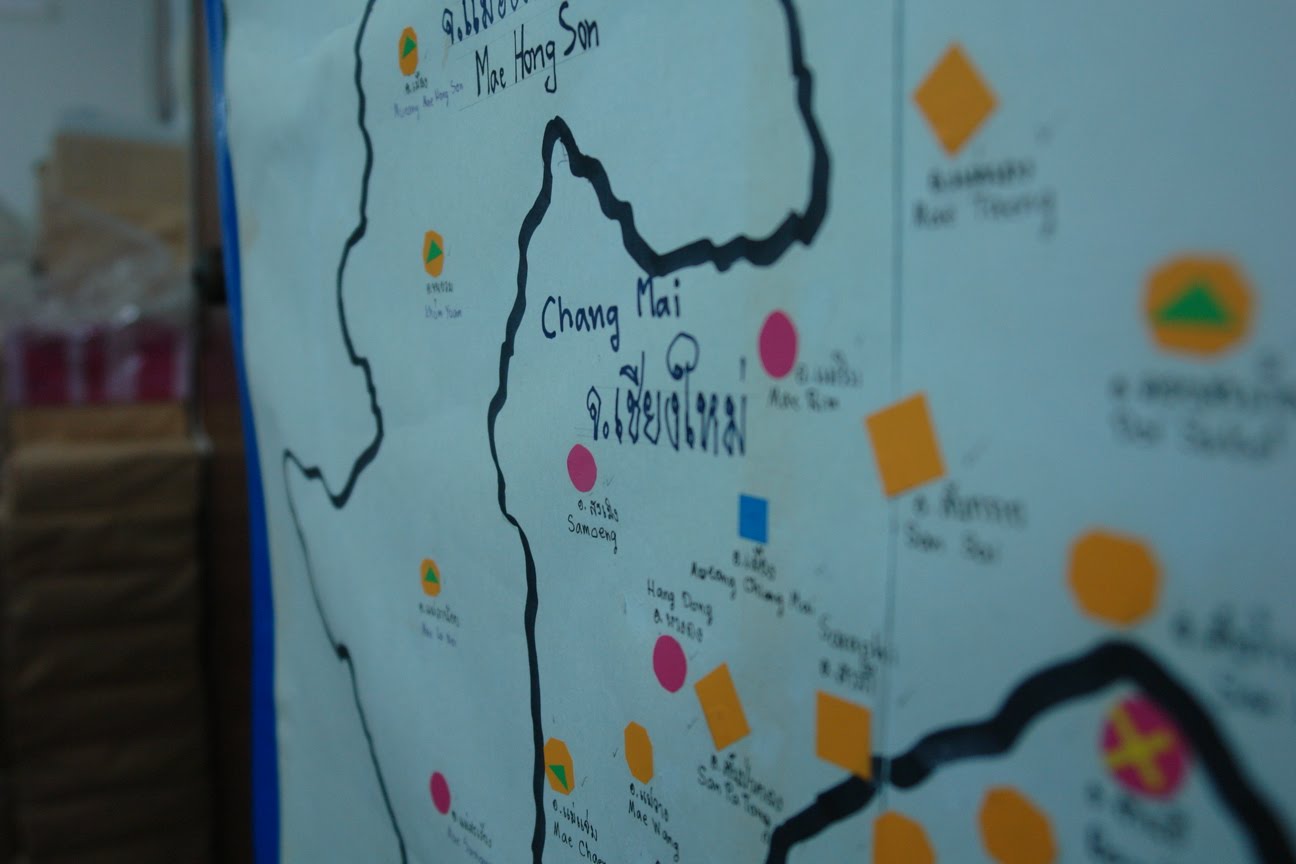
Map of HIV/AIDS groups in Northern Thailand

The objectives of this Foundation is to improve the quality of living of HIV victims, reduce the number of infected people, and help them integrate with society and return their lives to normalcy by removing the stigma that hovers over victims of HIV/AIDS through the Real Life Project. In addition, AIDSnet receives the support of local and international governments, Non Government Organizations (NGOs), people living with HIV/AIDS (PHA) and other community based organizations. The objectives of this Foundation is to improve the quality of living of HIV victims, reduce the number of infected people, and help them integrate with society and return their lives to normalcy by removing the stigma that hovers over victims of HIV/AIDS through the Real Life Project.

In the presentation by Ms. Mahawan we were told that their priority is the promotion of an improved health system. This is done through the organization’s close cooperation with the Health Department, providing blood tests and creating awareness among the people by educating them about contraceptives and how to live with HIV. The prevention campaigns are aimed particularly at groups considered as belonging to the high risk category- ethnic minority groups, youth, prisoners, the gays, lesbian, bisexual and transsexual community (GLBT) and men having sex with men (MSM). In order to help with their AIDS awareness campaign, AIDSNet also finds it is beneficial to them to co-operate with influential members of the community such as the monks, housewives and teachers, in order to reach a wider target audience.

Cyren conducting break-time refreshers

During the session we were also introduced to TNP+ as they work closely with AIDSNet to promote the assimilation of victims into the wider society. Mr. Kumona spoke extensively about the organization’s structure, activities and challenges that TNP+ faces. Through his speech, we discovered that the primary targets of their work- the ethnic minorities of Northern Thailand- reflected the recurrent interest of our trip in the marginalized groups within this region of Thailand.

Unlike other Thais, these ethnic minorities have limited access to health care and education, which is a major issue in controlling the spread of HIV. The seriousness of the HIV/AIDS situation in Thailand was highlighted when the speakers informed us of the reality of the situation where at least one member of each of their families is a victim of the disease. This reality is reflected in their endeavours which consist of organizing activities that involve the family of victims, who play a major role in providing support. Families, especially the children of victims, become involved in family camps where the organization will offer information, training and counselling. In fact, although the number of children that carry HIV virus is approximately 1,300, the number of children who are indirectly, but nevertheless, seriously affected is estimated to be 7,300. Similarly, the number of adults affected through proximity to direct victims is about 3,000 more than the number of victims themselves.

Mr. Kumona speaking, with Juta as translator

However all hope is not lost. With official statistics showing that reported AIDS cases have declined by approximately 90 percent between the periods of 2003 to 2006, it goes to show that organizations like AIDSNet and TNP+ have had a positive influence through the work that they do. Nevertheless, their work is far from complete. They hope to expand their work beyond HIV/AIDS aid and awareness programmes, branching out into other issues such as human rights, child rights and economic concerns.

By the conclusion of the session, we have discovered the relationship between the issues that are of our concern throughout our trip here in Chiang Mai. According to Ms. Mahawan, Northern Thailand is known to have a relatively higher rate of HIV infection cases compared to the rest of the country and this may be attributed to the fact that Northern Thais are primarily made up of minority groups who lack access to their rights and therefore, access to basic health care and education. During discussions, when questions were raised concerning sex workers, we were reminded of the fact that rather than dealing with sex workers directly, AIDSNet’s work is directed towards organizing networks and communities.

Presentation of gifts from Monash and ISOCM

We are looking forward to having our questions answered on Tuesday when we meet the group that advocates the rights of sex workers, Empower. The visit to AIDSNet has piqued our interest in the hope of learning more from the NGOs and groups that we plan on visiting tomorrow, true to the spirit of AIDSNet’s motto:
“No community or group can solve this alone; all must work together.”

Monday, July 12, 2010

Backpacking in a Nutshell

Written by: Sabrina Kamaruddin

While most of the town is surely filled with Thai locals, the road where our guesthouse is located does make you second guess: is this Thailand with Europeans or Europe with Thais? The backpacking culture is common among Caucasians and it could be said with conviction that all towns in South-East Asia – big or small – have been stepped-in by them. Asians, on the other hand, are still predominantly hotel-staying and suitcase-dragging.

Backpacking is a practice that Asian students have yet to grasp a proper understanding or acceptance of. Yet it is the best way a student could travel – we are young and strong enough to walk long distances while carrying 15 kilos of luggage on our backs, and we do not have to fork out a gold ingot (which we do not have) to go places. Studying in Malaysia means that we are surrounded by backpacker-friendly nations which are an hour away by flight, brief compared to the thousands of kilometres that Europeans have to fly over to get here.

For those who have had a taste of budget travel with Dr. Yeoh and are looking for more, here is a list of 4 things we must do to partake in the unfamiliar territory of backpacking.

1. Carry a backpack.
And leave the suitcase at home. All backpackers must carry backpacks; those bulgy looking things that hover over the heads of its carriers like a burdens expecting to be released. Although stupendously large, they are not as heavy as they look. Investing in a backpack pays off in the long run as they are highly durable and have a decent second-hand value.

Haversacks come in several sizes, but they are light and expandable to accommodate your belongings depending on the length of your trip. As much as you might usually love to keep things in order, backpacks are meant to be messy, and chucking your clothes straight in should be your newfound habit. If you go on long trips (2 months and above), you might find that throwing, donating or selling your clothes would be necessary to make space for souvenirs and new clothes.

2. Stay at a backpacker’s hostel.
You have not gone backpacking if you have not slept in dormitories and bathed in communal shower rooms. Hostels have much to offer: they are cheap and good for mingling. Decent bunk beds go for as low as USD10, and if you look well enough they come with great services such as WiFi, laundry service, travel advice, book loans or exchange, and even a simple all-you-can eat breakfast of toast and eggs.

Bed bugs are always a primary concern, especially when they get into your clothes and luggage and you take them home with you. A great way to avoid this and other inconvenience is to do some research on the hostel beforehand. Websites like HostelWorld.Com and Hostels.Com do not only show prices but also ratings, reviews, and even an up-to-date room availability chart.

3. Meet and mingle with other backpackers.
Making friends and exchanging information is a large part of the backpacking lifestyle. If you attempt living in hostels with a common area, you will bump into other travellers ready to befriend you. Muster the courage to initiate conversations, if you haven’t already, and go out to have drinks and a chat. It is possible to meet with other backpackers who have been to your intended destination as they could offer advice and recommendations. While travel guide books are a great way to get tips and pointers, they do not have mouths to answer your questions, so apart from great company, the friends you make during your travels could be saving your time and money, if not your life.

4. Be spontaneous.
Plan as you go. This does not mean that you do not need to prepare, but you should be ready and able to occasionally take risks and jump into decisions. From daily activities to accommodation, surprise yourself and friends at home as to what you are willing to do. Go for a two-day volunteer program, jump on the next train out of town, or get married to someone you met at the bar. Just make sure you can get an annulment the following day.

Tuesday, May 11, 2010

Profile: Sabrina Kamaruddin


Sabrina Kamaruddin is a second-year Communications student looking forward to cheap Vespa rental in Chiang Mai. A closet chatterbox, she dreads having to hand-write articles during the trip, and is half thinking of smuggling her laptop to type in secret. Despite being a self-declared IT illiterate, Sabrina helps maintain the blog and expects late night blogging sessions and a lot of grey hair upon returning to Kuala Lumpur. She dreams of visiting all corners of South-East Asia, and this year's choice of Chiang Mai seems to be a godsend. Her pet peeves include leg shaking and Serena Van Der Woodsen.

"If you want to meet a cat lover with a dark sense of wit and a sword for a tongue, then go say hello to Sabrina Kamaruddin. You are most likely to see her with a stoical expression on her face but with a whirl of stimulating thoughts and emotions in her mind. The B.Arts student from Monash University resides in Damansara Utama with her family of cats and some other people for pets." - Emily Chow for Sabrina K.