Showing posts with label Features. Show all posts

Sunday, July 18, 2010

Epilogue: In Search of Chiang Mai

Written by: Dr Yeoh Seng Guan.

The deadly resolution of the prolonged street protests in downtown Bangkok by the “red shirts” in late May caught worldwide media attention. Its immediate relevance for this year’s cohort of student travelers was that the annual study trip faced the likely prospect of cancellation because of security concerns. But information from various sources based in Chiang Mai assured us that the troubles were parochially confined to the capital city of Bangkok, situated some 700 kms to the south.

And so the trip proceeded safely as planned albeit with some minor hiccups along the way. Some of the many learning/talking points are faithfully chronicled in this blog before you. A few entries give a glimpse of the range of human concerns being compassionately tackled by various civil society groups based in this ancient northern bustling city situated close to the borders of Burma, Laos and Cambodia. They dig below the tourist gloss of Chiang Mai to reveal some of the forces that had caused many to flock to this city in search of a better life and to escape political oppression. Others provide investigative and impressionistic forays into aspects of urban Thai culture this past eventful week, the World Cup Finals notwithstanding.

As in the years before, a trip of this nature is not conceivable in the absence of the guidance and goodwill of a number of key individuals and civil society organizations. First and foremost, my gratitude goes to Dr Chayan Vaddhanaphuti, the Director of the Regional Center for Social Science and Social Development (RCSD), Faculty of Social Sciences, Chiang Mai University, for kindly agreeing to be the host institute and for providing various suggestions on possible input sessions early on.

Ms Kanchana (RCSD) helped to source out our able and hardworking student guides and tackled last minute logistical challenges efficiently. Ms Amema Saeju (Mimi) was instrumental in making contacts with the community leaders of the Attaqwa Mosque whereas Ms Busarin and Mr Ton similarly paved the way for us to meet with the other civil society groups.

Our accommodation in Chiang Mai this year was truly exceptional! Ms Sunanta Thakas (Sin), the proprietor of Yourhouse Guesthouse, not only looked to everyone’s needs with great care but her extensive contacts in the business lighten considerably our organizational worries.

Last but not least, our four student guides for this year - Ms Jamjuree Janjorn, Ms Jutha Srivatananukulkit, Ms Penkwun Chumpukum and Mr Kitikhun Suja – shouldered the heavy responsibilities thrust upon them with cool grace and humour, and in this way has continued the singular tradition of student guides extraordinaire.

Of the six study trips organized thus far, this is the bumper year in terms of the number of countries represented by the student travelers – Australia, China, India, Indonesia, Malaysia, Sri Lanka and Zimbabwe. Once again, I am happy to note that, on balance, this cohort was able to rise to the challenge of negotiating a steep learning curve in an unfamiliar environment with much enthusiasm and flexibility. They were joined by veterans of previous study trips and former student guides from the Philippines, giving this particular trip a special aura in terms of networking opportunities.

For me the central lesson of this year’s study trip to Chiang Mai can be epitomized in an imagery used by Gabfai, one of the groups visited. Learning to listen intently to others, especially the marginalized in society, is akin to unfurling one’s clenched fists and letting go with what we are familiar with. Without this mindful disposition, one cannot get to the heart of the matter but remains in a state of aggressive denial. For this cohort, I hope this trip will be remembered in this manner for years to come.

In-formation at Wat U-Mong

Closing Entry by the Editor-in-Chief

Written by: Nadiah Ahmad.

Chiang Mai posed for many of us an opportunity to get away from the familiar and learn about, what seemed like, an unknown and mysterious backyard. Thailand, a country situated just above Malaysia, was a place many only associated with Bangkok and Phuket, and so the location was in itself enticing.

When I signed up for the trip, I did not know anyone in Monash beyond my ridiculously tiny social network. Many of the travellers were already acquainted with each other, having shared classes or similar social groups. When I was given the task of chief editor I shuddered at the notion of organizing a bunch of art students who, by definition, should not be prone to the notions of organization and deadlines – I, for one, still struggle with them. But having said that, I was pleasantly surprised at the work ethic that came with each team, and so felt assured of the workload given to us.

We arrived inquisitive, though slightly sleepy, at Chiang Mai Airport, and the transportation that greeted us was both unexpected and exciting; pick-up trucks with roofs, and which soon became our main mode of transport around the city, was one of the pivotal settings for the groups of us to get to know each other. It was also a place for Abeer to release her frustrations and boredom by singing the Sesame Street theme song.

Days passed rather slowly for us, early mornings and late nights; when it was three pm, we hoped for it to be six. Even so, each hour we spent, we learnt, laughed and sang. Work was done, though admittedly, not always on time. But the times we shared, we shared willingly. Getting to know one another was part of the incentive and became one of the main reasons we did not want to leave the country. Our student guides assimilated themselves to be one of us; they shared stories and experiences with us and vice versa, and because of that, they have left a lasting impression in our hearts and minds.

There are a couple of things that must be highlighted to single out this trip from others, making it (and this is my biased perspective) the BEST student trip EVER. One of which is, unlike the previous ones, the lack of a definitive setting in which previous travellers saw as mandatory – the cyber cafe. I have heard stories of previous travellers bonding over the brightly lit computer screens at cyber cafes. Though a few of us did do our work as one, most of us (and by the end of it, all of us) were instead stationed within the confines of our rooms or the makeshift studio at the guesthouse to finish our work.

We instead bonded over football, Singha beer, saman, banghra, talks about the trauma of sex shows and Muay Thai, and a group effort to get a couple of travellers emancipated from their denial of mutual infatuation. Considering the circumstances (or lack thereof), the travellers ended up seeing each other as more than just course mates; indeed, we are all now friends.

Another peculiar factor present within our group was the multiplicity of nationalities amongst the travellers. We had Malaysians, Indonesians, a Sri Lankan, an Indian, an Aussie, a Zimbabwean and a Chinese whose eagerness was infectious. It was interesting to see everyone break out of their national shells, and embrace each others’ idiosyncrasies. It was not only a trip to learn about Thai culture, but the culture of our fellow travellers, and most of us gained a plethora of knowledge, not excluding suave dances moves.

Dr. Yeoh, our Pathfinder and head honcho, set out planning this trip for us to learn about the world in ways we could not have in the pages of our course readers. He wanted us to learn by experiencing, by watching and hearing stories of struggles and triumphs. Personally, I think he wanted to reassure us of our ideals, and to hopefully retain them once we are released from the confines of our Monash gates. I wish for his plan to work, for the world is a reality that needs a necessary dose of idealism, which then hopefully this bunch of travellers can provide.

Reflections by Cheah Wui Jia

Written by: Cheah Wui Jia.

Sometimes it seems like heaven is a place on earth.

At the mosque we were visiting, I saw the young girls clad in tudung, running around joyfully, as if there were no such thing as pain in life.

And I took it all in, smiling. It seemed… so pure. I smiled at a young child and she smiled back at me, before running somewhere to hide behind a door. I thought my heart would burst. Dramatic, I know, but me, being the sentimental freak that I am, just cannot help myself. While they scuttled around like little mice playing hide and seek, I understood what purity may possibly mean. Trust. Devoid of fearfulness or presumption. Children love with an innocence that no adult can ever understand. They don’t see the colour of your skin. Or your body shape. Or whether you are doing drugs, or sex work. They just love you if you give them candy. Or make them laugh.

It makes sense. Loving the human being. Imperfect in many ways but, nonetheless, human in every way.
The people that I have met are pure at heart. Strangers I come across in Chiang Mai clasp their hands and say “Sawadika,” with a humility that the world needs most in a contemporary age of despair and disappointment. Institutions of authority have failed us in one way or another. Corrupt organizations, themselves comprising fallen human beings, have swindled away hopes and lives like conscience never existed. We live in a period when truth seems elusive, when motives are incessantly questioned, when ideals evaporate to leave an arid desert where dreams are nothing but mere shiny mirage, when a flurry of ideology seems destined to implode under a heavy weight of contradiction.

But out of brokenness and sorrow comes forth a faith that can be purer than gold. Faith is that transcendental signified that we so desperately need, in a world full of flickering simulacra and empty signifiers. Faith is that wall that came crashing down when a crowd that shrieked for joy climbed over its remnants from the East into the West of Germany. Faith is when a woman, shackled under house arrest for 14 years, still possesses a heart that drums to the beats of freedom, because she loves her country too much to sing mournful desert songs. Faith is when we relentlessly decline to have our hope dictated by the shifting conditions of surrounding circumstances that may seem hopelessly negative.

We can choose to turn cynical and hard hearted, deriving certainty from a postmodern form of numbing depression. We can choose to casually shrug, or complain out of bitter resentment and throw our hands up in the air. Nothing is going to work. So why try?

Or we can choose to make a difference, rise to the occasion and believe that we can change things. That we can love, and make purity possible.

The NGOs I have visited demonstrate signs of an unfaltering faith. Caring for refugees who flee from tyranny and oppression, for sex workers who suffer from stigma, for AIDS victims whose lives are dwindling a little each day. In other words, people who have dedicated their lives towards caring for other people who may have to keep looking over their shoulders with a gaze so furtive, clutched by a fear so paralyzing it makes it difficult to breathe easily.

I wish I could describe to you, in words, my study trip at Chiang Mai. But I can’t. This doesn’t stem from a sheer laziness to type out this diary entry, or from the belief in a Lacanian theory that language is hopelessly unreliable. Words just cannot do justice to the study trip. I wish I could taken you by the hand, to urge you to walk with me and absorb the sights, sounds, tastes, feelings that so profoundly, in the words of another diary entry, assailed me, at every phase of the trip. I can only offer you snippets that I hope, paint a picture of Chiang Mai and the people that I encountered.

I will be unapologetically honest now. There were times when I questioned what faith and love really mean. In many ways, my Christian faith was violently at odds with the lifestyle of the homosexual or the sex worker. I knew I had no right to judge anyone either. Smoking, drinking, cursing, and cracking jokes (that made me blush or gulp), were what some of my friends did on a regular basis. Habits like these were something I had to accept, and attempt to overlook. Constantly surrounded by church members, I had been accustomed to the habits of the devout Christian which clearly excluded behavior deemed as worldly or ungodly. But I knew I had to suspend my judgmental tendencies, and accept differences in doctrine (Christianity versus Social Science) that threatened to mar the entire Chiang Mai experience for me. I had to learn to love, over and over again. To unclench my tightly clutched fist, over and over again. I prayed at night, asking God to help me understand and love people better. 

At the ice breakers exercise that kicked off the GABFAI session, I fully understood the entire painful exercise of trying to keep my clenched fists closed (while an annoying opponent tried to pry it open). When Ann asked how clenching one’s fists felt, some of my friends automatically replied “It felt powerful, like I was in control”. For me, before the exercise was over, I already knew its aim deep down in my heart. It is safe to feel as if one is in control. Safe to know that the world is clearly mapped out and highly predictable. But that is not the real world.

I understood what Dr Yeoh meant when he urged us to leave our comfort circle of friends and attempt to spend time with acquaintances beyond our familiar cliques (or “factions”). Judgment barely begins with people on the fringes of society like the prostitute, or the hardcore drug addict, or the homeless refugee. It begins with the people we come into contact with in our daily lives. People whose lives are ordinary, just like ours. If we cannot overcome miniscule differences by loving one another unconditionally, we cannot expect to bridge the larger gaps that divide the centre from the periphery in society.

For the record, the adjective “lame” hardly means Lochna’s sprained ankle. I truly enjoyed the company I had. I felt honoured being there among them.

Saturday, July 17, 2010

A Journey Across Three Borders

Written by: Eunice Phang.

With my fellow alumnis, I took a day trip to visit the Golden Triangle. Considering it would be a long ride with the total of 600km, with no haste, we headed north of Chiang Mai at 7.15am while other pathfinders were still deep in their sleep. Along the trip we made a few stops, namely Laos, Myanmar and Chiang Rai.

First stop was the White Temple (Rong Khun Temple) which is said to be a symbol of holiness and purity. The temple is ornamented with white glass as a symbol of Buddha’s wisdom shining all over the earth and the universe. This temple is owned by Chalermchai Khositpipat, a famous artist from Chiang Rai. The artist used his savings from selling painting to build his dream “Art for Land Project” where he used his interpretations of Thai Buddhist art and culture to form the White Temple; it was his way of giving thanks and contributing to his home country. Situated along the highway, it is indeed an opulent sight from a far. Strolling in and around the temple, one would discover that the landscape design of the temple and sculptures had been given underlying Buddhist meanings and values.

As if descended from the heavens, the White Temple

But what I think was the highlight of the temple (and which I found pretty amusing) was the murals in the temple which unfortunately were not allowed to be photographed. Unlike classical Buddhist murals that show the Buddha’s path to enlightenment, these murals portrayed the context of human history; depictions were aided through the use of popular comic characters and weapons of mass destruction. This juxtaposition of modern symbols and discourse against ancient Buddhist story-telling tries to emulate the “reality” of the modern society which would normally be seen as a threat to traditional Buddhist values, or even to the future of humanity. It is very interesting to see characters such as Neo from Matrix, Darth Vader from Star Wars, Marvel heroes such as Spiderman and Batman etc. These post-modern art works requires the viewers own interpretation for the work to be meaningful; to some it might give an impression of the lack of seriousness, but it could also be a reflection of the modern world affected by globalization and capitalism.

Hands that speak of repent? Or of redemption?

After enlightening ourselves with Thai artwork, we made our move on the Mekong to Laos. There, we visited the local bazaar that sold all sorts of trinkets, silk scarves, wooden carvings, and, much to our surprise, COBRA WHISKEY! Obviously a tourist would have a rage with this exotic drink; the whiskey came in a variety of other flavours from Gecko to Scorpiono, there was also a combination of all poisonous reptiles, but this apparentlt reserved only for the brave. However as these whiskeys are known to be somewhat of a traditional aphrodisiac to make men … strong in places unspoken, it then does not take a brave men to drink the whiskey, but a pretty insecure one! Out of curiosity, I sought for a reaction frommy fellow tourists who tried a few sips; unfortunately, the claimed effect was yet to be felt, but they did feel their body heat rise.


Reptile whiskey

Our next stop was to the border of Thailand and Myanmar where a fellow traveler and I were fooled into illegally crossing borders to Myanmar only to be greeted by Burmese officers who extorted 500 baht from us each because we did not have proper visas; the haunting and evil laugh of the lady officer who found amusement in our cross-border misery added insult to injury as we all knew if we did not pay, we would risk becoming border refugees. And so with the last of my Bahts, I bailed us out.

Of awkward borders

Moving on, and never wanting to look back, we headed to the Karen village situated in Northern Thailand to visit the hill tribes. Honestly, the place has become to tourist-like to the point where all the villagers are already dressed up, made up with flower garlands on their hair, ever ready to be photographed. They make a living from selling crafts to tourists, yet most tourists were just snapping photos away as if at a zoo. The village ladies and little girls are indeed very professional and camera sensitive, posing every time they sense a flash with a “botox” smile as a way of initiating the tourist to buy from them. Indeed they were satisfying the tourist gaze in us.

The price of beauty

The most memorable tribe would be those of the long neck Padaung which has garnered lots of interest in anthropology and feminism. The Padaung women are subjected to wear heavy brass rings around their neck, ankles and arms at the age of 5 onwards. According to ancient myth, it is to protect them from tiger attacks. Some say it is their definition of beauty. The reason that these women still practice this traditional culture could be to preserving their cultural identity or to capitalize on their way of living for the tourism industry. In fact, there is much discussion that these “cultural villages” likened to human zoos, where mistreatments are rife as some of the “villagers” are illegal immigrants or refugees. When asked if the process of adorning the brass rings were painful, they all gave a much scripted answer of it being a painless process and that they are used to it. As much as it should be a cultural heritage, deep down I do feel sorry for the girl who carries such physical burden in their daily lives.

This marks the end of the Thai-Laos-Myanmar exploration. An honest review on the trip? Eye opening but not worth the money, it felt a lot like a scripted reality show throughout and even the guide’s jokes appeared rather unnatural. It does give legitimate bragging rights that you have spanned three countries in one day, but I would rather spend on Thai massages. Enough said.

Alumnis and former student guides unite

Cultural Diversity in Chiang Mai, Thailand

Written by: Jamestar Matani Ruwisi.

Thailand’s recorded history dates back 5000 years ago. Thailand has was never been colonized and for this reason the country has never been detached from its culture making it unique. The country’s heritage is emulated on their, palaces, shrines and ancient sites that define exclusive Thai architectural styles and amazing designs and these designs have existed from the period 1782 to present day.

Chiang Mai is located approximately 700 kilometers from Bangkok, it is one of Thailand’s famous and commonly visited provinces. Chiang Mai is an amazing state within Thailand and is one of the most historically significant provinces in Thailand. Chiang Mai accounts for numerous temples and ancient sites; Chiang Mai becomes an important site to experience Thai history in the present.


A temple! OMMMMMMMMM…

Chiang Mai has a distinctive unique culture which encapsulates, historical sites, temples, cultural shows and cultural centers, Thai traditional ways of life, museums, theatre and dance festivals, some of the temples include Doi Suthep, Wat Phra Sing and Wat Chedi Luang, Wat Phra Borommathat. Chiang Mai and the entire Thailand population hold a strong culture based on what it means to be an ideal Thai citizen. Chiang Mai’s vibrant culture is one of the key reasons why tourists visit the country. The culture plays a pivotal role on keeping the people together and tourists are mesmerized by the overwhelming state of art performances which are characterized by massive wave of utopian enthusiasms.

Chiang Mai has three dominant religions which encapsulate Buddhist, Christianity and Islam. Buddhism is however the widely practiced religion in Chiang Mai.
Three Kings monument in front of the city’s Museum; commercialism for cultural preservation

The world has become transnational and global movements of people and diffusion of cultural values and the ensuing interdependencies make it necessary to live together regardless of the nature and form of differences and how people respond to them. Mrs. Moi of the Muslim community alluded that diversity exists amongst different religions “In Chiang Mai, all three religions work and leave together in the communities without discrimination”, in other words the people of Chiang Mai have managed to successfully engender peaceful coexistence regardless of differences that exists in religion and this can be acknowledged as a remarkable achievement as religion is usually a factor for fractions in societies. Chiang Mai is also well known for the unique existence of copious tribal people and their villages are frequently visited by tourists; addding to the place’s uniqueness.

Of commemorating the invisible

It also important to note that Chiang Mai’s distinct cultural significance has staged a massive show of prowess on cementing the constant and continuous presence of tourists. This has created a solid platform for constant existence of diversity in Chiang Mai that is people from all walks of life coming to experience the amazing cultural performance of the Thai people. Thailand has a unique hygiene system, shoes are regarded as dirty and it’s unacceptable to wear shoes inside the house. This exercise is also prevalent in some business centers, and in temples.

Chiang Mai has a lot to offer. It is also often referred as the “Rose of the North” due to its compelling sites and views that make it culturally strategic and an economic focal point for tourists across the northern region of Thailand.

Friday, July 16, 2010

The Lady of Yourhouse

Written by: Paulista Bunga and Nadhiya Najab.

“Welcome to “Yourhouse Guesthouse”! Take off your shoes and treat this as your own house as this is no longer my house” was what greeted us as we arrived at our destination in Chiang Mai. “Yourhouse” guesthouse was where we would be spending our nights and whatever free time we had and because of Aunty Sin it was a place we called home for the duration of our stay in Chiang Mai.

Miss Sunanta Thakas, fondly referred to as Aunty by most of us became an integral part of our visit to Chiang Mai as she was more than just our land lady but also a friend and a primary go-to person for anything we could possibly need from breakfast to telling us about places of interest, helping us get tickets and most importantly discounts for almost everything we could want via her impressive connections within Chiang Mai.


Auntie Sin: All smiley at work

Her warm personality and her perpetual smile each time we met her left a definite impression on us, making us wonder what put that smile on her face. So we sat down with her to find out more about her past, her present and her plans for the future.

Coming from a very poor farmer’s family, she was determined to have a better life than if she had remained in her hometown of Lamphun and so she came to Chiang Mai at the age of 20 to help her cousin run the guesthouse. She was involved with almost every aspect of the operations from the restaurant to reception, provided her with enough experience and confidence to open up her very own guesthouse in 1990. Starting small with only 6 rooms, she has gradually expanded to three properties with 44 rooms in total. The guesthouse we are currently occupying is “Yourhouse” 3 the latest addition to her operations, coincidentally the only one belonging entirely to her.

According to Aunty Sin, down the street from where “Yourhouse” guest house is situated used to be quiet and full of greenery but today when we walk down the street we find a number of other guesthouses and eateries, all catering to and competing for the patronage of visitors. The increase in competition together with the political situation earlier in the year resulted in a decrease in the number of foreign tourist to Chiang Mai with room occupation rates dropping to as low as 5%. However, after having experienced the hospitality and her friendliness we have no doubts that once the dust settles around the political situation “Yourhouse” will be back in business and she will hopefully have to fight off the customers wanting a slice of heaven at the hand of Aunty Sin.

The fluency of her English and her occasional use of French words when conversing with us had us wondering what influenced her to learn the languages. She told us about only having had four years of formal education but her interest in the hospitality trade increased her enthusiasm to learn different languages to be able to better communicate with her guests. Her French was further improved when she married a French man in 1989. This marriage however did not last very long as they separated after 8 years because the differences in work ethics which made it difficult to maintain their relationship. This had not stopped Sin from achieving her goals in life. The end of her marriage with her husband who was also a friend and business partner had reinforced her determination to never mix business with pleasure.


Auntie Sin coming to show support for our cultural performances

Attending to the needs of her guests is a full time job which leaves her with very little free time. Aunty Sin however does not see this to be a shortcoming because she enjoys the opportunities available to her to meet new people and considers this aspect to be the highlight of her job. When she does get the opportunity, Sin likes to meet up with her girl friends for a “ladies lunch” where they talk, gossip and catch up with each others lives. Though she spends little time outside her work, there is a connotation that her work is her life, both social and personal.

In terms of her plans for the future, they are not definitive. Realistically, she would love to expand her business to include a Thai cooking school conducted in French and also a swimming pool. Presently however, she lives for the day, as it provides enough fulfillment to better prepare her for the future.

A warm, bubbly and welcoming person, Aunty Sin has definitely made an impression on each of our travelers ensuring that if we were to visit Chiang Mai again a stay at “Yourhouse” would definitely be high on the “to do” list.


In front of Yourhouse, no, Ourhouse.

Thursday, July 15, 2010

Thai Massage for Dummies

Written by: Marsella Agatha

As we might continue to place upon ourselves the stresses on daily basis, the nurturing hands of masseuses would be an extraordinary method to sooth your senses and free the tension within the body. Thai massage as one of the wide variety of massages, is renowned for the healing treatments for mind and body which has been proved for over years.

Thai massage originated in India then made its way to Thailand through the transmission of Buddhism. This exhilarating treatment has been traditionally practiced by the monks to induce a calming effect on the minds as it gives relaxation with meditative quality. Thai massage bases its treatments on numerous practices, namely Chinese acupuncture, Ayurveda and Yoga; this treatment bases its principles on maintaining the flow of circulation in the body by focusing on the ten invisible energy lines called Sen. According to Mr. Lex Red, the teacher of Chang Daeng Thai massage school, it is vital to remove any blockages along these energy lines to enhance a smooth flow of blood circulation and energy throughout the human body system.

Among the plethora massages that exist, none intrigued me as much as Thai massage. Therefore, I had been contemplating on the idea of experiencing this form of heavenly practice on one of the last days of this In Search of Chiang Mai trip. Chang Daeng Thai massage was recommended by our guesthouse host, Aunty Sin, a convenient place just fifteen minutes away from our guesthouse.

They offer several types of massage namely Thai, foot, and oil massage. The use of oil is not essential in the traditional Thai massage yet nowadays, it is acceptable to blend the use of oil in the modern Thai massage. The appliance of oil will enhance numerous benefits, i.e. softens the skin, nourishes the skin, gets rid of dry spots on your skin, and eliminates toxins from your body. The relaxation process is enhanced with the choice of being massaged on a paddled floor mattress or bed. Mr. Lex Red distinguished between those two; the first is designed for a stronger pressure massage while the latter is designed for the light or medium. Another characteristic of Thai massage is that it does not require the removal of clothes as an authentic loose fitted clothing will be loaned - to facilitate comfort during massage.

The massage begins on the right leg and ends on the left, each spanning 25 minutes. Followed by a hand massage for 10 to 15 minutes and then back massage for another 20 minutes. The final 10 to 15 minutes is spent massaging the head. Each Thai massage movement also incorporates slow stretching movements which are carried out continuously to ensure a release of tension in the body, thus leading to a complete relaxation and soul rejuvenation.

Some of the techniques are very much feels like Yoga; the practitioner will manipulate the client into different yoga positions throughout the session. It gets painful on each of the tense areas. In my case, it was around my leg: I could not help but scream when the thumb of the masseuse pressed my nervous muscle in order to release the blocked energy along the Sen lines. With that said, the massage did relief the tension in my legs, and my body as a whole – this becoming a testament to Thai massage’s effectiveness. For only 450 baht (RM 45), one can experience two full hours worth of Thai massage, which acts as a very effective form of stress relief. A refreshed spirit, calmness, balanced nervous system and an increased energy are some of the tremendous benefits that can be reaped from the overwhelming bodywork experience of Thai massage.

In Chiang Mai, you can stumble across Thai massage parlours at almost every corner, however not all of them are equally professional. The original Thai massage, involves many specific steps, ability to know specific parts of the human's body and also a lot of experience. Therefore, it is vital to try to find a masseuse who knows how to do the real Thai massage in order to reap the full benefits of this uniquely Thai experience.

For the Love of Balls

Written by: Eng Sze Jia.

Of course, I could have chosen to stay back at the guest house to catch up on sleep and avoid the crowd, but what a waste it would have been if I had done so, instead of being out there to witness a sea of supporters of Holland and Spain! If there is one area of knowledge I fail in, it’s my knowledge in soccer. And with that, the existence of the World Cup has systematically marginalized me from all its hype and daily conversations with people who would ramble on and on about the matches that happened the previous night.

Unlike mamaks back home, the vibrant Chiang Mai night life is filled with great bars and taverns that are frequented by many tourists and backpackers. The main reason why I decided to go out that fateful night was because my roomies convinced me that by staying back I would be missing out on a chance to witness a moment in world cup history a) in another country, b) with this sort of company, and c) in a place like Thailand. We did not need to endure an extra hour of sleeplessness that night, since the time in Thailand is one hour behind Malaysia.

But on a more honest note, I am a skeptic of the (in)famous Paul the octopus. I went out also because, along with my bunch of friends, I really wanted to watch it predict the results of the match wrongly. As soon as we walked down the lane into the main road, we saw a sea of people who were wearing orange and crowding in front of the The Wall - a Holland bar, whose existence is not surprising, since Chiang Mai is frequented by many Europeans. There was also an Irish bar just across the road, situated at the opposite of the Holland bar. A litter of red stood here and there seemingly unperturbed. The orange people kept on coming; climbing out of tuk-tuks and zooming around with scooters flocking the area.

In our troop of seven, there were two Spain supporters; decked in the Spanish jersey, we braved the stares as we walked past one bar after another and cheered with fellow Spanish supporters.

Since the bar that we planned to go had its crowd spilling into Ratwithi Road, we walked around in search of a cosy place that could accommodate us (and our rather tight budget) somewhere nearby. We finally settled at John’s Place two blocks away from the screaming Holland fans. We sat at the balcony, where we were greeted by the beautiful night scenery of Chiang Mai’s historical moat.

The part that affected me the most was that tourists were complete strangers to one another but became friends through undignified collective euphoria. A howl would echo in unison every time the team missed a goal. In addition, we were united in a lack of comprehension of Thai commentary. Yet the occasional names mentioned in English gave us a sense of place. It made us feel like we had finally arrived in Thailand. As I occasionally glanced at the road while watching the match, I noticed there was barely any traffic.

With beer in one hand and clenched fist in the other, Spain’s goals were an emotional release for those who had been supporting Spain, and also for those who wanted to go to bed. As many thank yous, goodbyes and profanities were exchanged, it was a pity that the two Spanish supporters had to wade their way through a sea of orange. Such is fate that they had the last laugh. The Octopus was right. Blast!

We can only speculate if the magic of the octopus would continue to live on.

A Delight for the Tight-Fisted

Written by: Abeer Yusuf

There is only one word that can aptly describe the shopping in Chiang Mai- ridiculous.

Roads and rows of souvenirs and knick-knacks line street after street, enticing one to pursue the time-consuming sport of shopping. Vibrant colours of token t-shirts and traditional sarongs flash past wandering eyes while sounds of tourists bargaining for lower prices in broken Thai fill the air. Welcome to Chiang Mai, land of dirt cheap prices and wealthy wallets.

Here one can seem to waste away thousands, only to come back and see that their amount of shopping is directly disproportionate to the amount spent (I meant this in a good way); not to mention, the quality of goods makes the money spent all the more worth it.

Shopping in Chiang Mai is till today very much traditional; shopping malls not having taken over the presence of the markets, unlike most other tourist destinations. In fact, there are only 2 shopping malls within the city, which are mostly favoured by the local students in search of some ‘air-conditioned’ respite from the blistering heat. Three of the most prominent markets here are the Night Bazaar, the Sunday Market and Warorot (Kad Luang) Market. Locals are obviously sold goods at cheaper prices as compared to foreigners, but prices are not highly marked up excessively for tourists, thereby not denting wallets much.

A young boy using his laptop while selling bananas

In analysing the shopping on offer, the writer has come up with three levels of identifying the goods sold. First, the ubiquitous t-shirts, key chains, magnets are the usual fare one can expect to find anywhere in the world, with the name of the particular city and country branded onto it. Second, the unique things Chiang Mai has to offer, which sometimes requires a bit of searching and looking below the surface, is not always obvious to the skimming eye; perhaps not always cultural but always creatively unique. Third, the things that belong to no particular region, currently in high demand, are modern artefacts that have no particular origin, homogenous commodities local to none, yet global to everyone such as paisley bags and hair bands.

The first market of interest was the Night Bazaar. Located in an upscale tourist area, the entire shopping compound is almost endless. Stall after stall offers enticing products like brass bracelets, flower shaped candles in lacquer boxes as well as traditional Thai silk and menswear. Bargaining here is a must-do, because each vendor will convince you that he is offering you a ‘special price’, ‘just for you’ which no one else has had the opportunity of being offered. Obviously, the price initially offered is a highly marked up price, therefore the best tip is to go as low as one can go, attaining a happy balance with the seller somewhere in between. There is one particular market situated within the Bazaar, where most of the stuff being sold outside can be found and bought at wholesale prices.

There is also a food court where dinner can be purchased using the coupon system. As such, it’s a good idea to get to the Bazaar early (it opens at around 7pm) to avoid rush hour and sweaty fellow shoppers. Another idea would be that since the Bazaar is on every night, and is just as crowded, any purposeful shopping that needs to be done could be done on Sundays when the rush is diverted to the Sunday market.

Coffeemobile!

The Sunday Market is perhaps the most important market in Chiang Mai, where both locals and tourists come out in throngs to simply shop. Beginning at Rachadamneon Road and stretching on for almost five kilometers. The only way to properly describe this market is epic. Literally everything and anything is sold here, from bees to stools shaped as cans to green pots that grow grass all over themselves. It may sound a bit nonsensical at this point, but one really must experience this extravaganza for themselves. The writer herself is a self-proclaimed connoisseur of markets, but in terms of the sheer awesomeness - for the lack of a better word - this market takes the cake. Case in point – mobile vans functioning as coffee bars. Not weird enough? Throw in a TV blaring Thai entertainment in the same van.

An elder one man band

As the entire market rests on two sides of a lane, the centre of the road functions as an island for performers to showcase their talents. Men and women, young and old, all perform for the walking public, with hats and musical cases open for any hands generous enough to contribute. Another extremely interesting concept is the amount of support the market gets. Along the entire stretch, there are a number of temples which for this one night (roads are cordoned off too) open up their premises to let sellers in, to sell their wares. Many sectors are even divided into food, clothes and such.

Yet another interesting observation is how the vendors all display their identification tag, which formalizes the entire night market process, not only preventing hawkers from unfairly poaching on potential customers from the licensed sellers, but also allowing the sellers to formalize the sale of their goods. Some vendors even wear a uniform. A word of caution though- bargaining as a true skill is really put to the test here, as vendors rarely refuse to mark down exorbitant prices.

The third market, where again, everything can be found, is the Warorot Market. Open during the day and favoured by the locals, its the busiest market where food, flowers and even fowl can be found in true, market style; brushing against tons of sweaty shoppers, bothered by the heat and sticky from the grime and grease of the atmosphere.

Hand-painted cards

So what’s good for tourists to buy? Apart from the first and second levels of shopping described above, there are traditional Thai music CDs, hair pins with beautiful exotic designs, organic skincare brands (on the streets yes!), hand-painted cards with traditional motifs, silver jewelry, and fairy lights in inventive shapes. Keep an eye out especially for brass jewelry as it is unique to Chiang Mai together with cheap traditional Thai original art. Temple ornaments are also easily available and make unique home décor.

Fancy lights which go for very cheap

One stall even sells clothes for dogs at the Sunday Market while another sells bikinis, all in one place. An interesting situation to look out for in these markets is also how the vendors combine the pursuit of entertainment with business where many vendors have their own portable DVD players or laptops which they use when not attending to a customer, a trait not quite common elsewhere. It is always an experience to eat local street food, such as ‘ancient ice-cream’ or taro puffs. Dinner at markets, as written above, is easily available, and at relatively cheap prices.

All together, shopping in Chiang Mai is an experience like in no other place, maybe not even Bangkok. Just make sure you plan your trip to include a Sunday.

Friends Without Borders

Written by: Eng Sze Jia.

Friends without Borders is an international NGO that focuses on promoting Human Rights and educating people about the issues related to indigenous communities, migrant workers and refugees. For instance, the people who they work with in Chiang Mai, Thailand are mostly Burmese refugees. These refugees risk their lives coming to Thailand in search of a better life, which their country’s authoritarian government cannot provide. These people who flee political violence are vulnerable to be exploited by agents, traffickers, on the way to Chiang Mai, and upon arriving at their destination.

Pin, the coordinator of the organization, explained to us a variety of dangers that both adult and children refugees face. The organization works to educate migrants about the rights they are entitled to, and also raises awareness about the plight of the refugees among the general Thai public. Apart from written publications and conferences, they also produce short films which provide a more visual account of their cause.

Hongsa’s School Bag (2009), produced by Th’blay Paw tells the story about an 11-year old boy of the Mon ethnicity who was born in Thailand. Hongsa lives with his parents who are migrant workers in Thailand. He receives the opportunity to attend a Thai special class for migrant children. He also yearns for a new school bag. In addition, he faces different types of pressure with the hope of gaining access to education and therefore, to a better quality of living. This film successfully shows what is at stake for migrant adults and children in Thailand.

There are humanitarian efforts in Thailand that allow children to attend Thai schools upon completion of a special course that teaches them Thai. However, children still face trouble in integrating themselves with the local children. Burmese children are often told not to mix with the Thais in fear of offending them and getting deported. At the same time, they are also misunderstood by the Thai society which segregates the two groups of children. Burmese children are also vulnerable to extortion, physical and sexual abuse. Pin explained that some girls or boys who are abducted become victims of human trafficking. Boys are sold to work at sea, while girls are raped and abandoned or forced into prostitution.

Mon people are Burmese who live along the Thai border. There are an estimated number of 3 million migrant workers in Thailand from Burma. Based on the media monitoring project that the NGO has conducted, Pin explained that mainstream media does not portray migrants in a favourable light. The media also uses migrants as a scapegoat of violent crime during the recent political struggle. Hence the migrants are usually misunderstood by society.

The Thai government requires them to obtain documentation. However, the procedures of applying for legal documents can be very difficult to access and expensive. Registration only allows them to be a temporary resident for 4 years. The reality is that they extend their stay beyond that permitted period. Hence, these Burmese migrant workers, both documented and undocumented, face risks of deportation or detention. Also, their job opportunities are nowhere near promising, only being allowed to take up jobs that locals are unwilling to do. In addition, they continue to risk deportation by their employers for misbehavior or improper conduct.

Pin explained that workers are paid less and do not always live in comfortable conditions. She said that Thailand seems to appreciate their labour as a means of boosting their economy, yet do not want to accommodate their family. Migrants of Mon ethnicity flee from political violence as a family instead of moving individually (individual migration). Children who are born in Thailand do not obtain proper documents, which make it difficult for them to gain access to education and health care. They constantly live in fear from deportation. If an adult gets caught and deported, this effectively separates the parent from the child. Upon being sent to the border, migrants are charged a fee by human traffickers to be sent back to Thailand. Hence they slip into debt again.

Migrants are an exploited people. It is therefore crucial that their rights are fought for.

 Goofing around outside Friends Without Borders Headquarters

The Hills Come Alive With The Sound of Chiang Mai

Written by: Low Weiyan.

As soon as we pulled over at the Yourhouse hotel, we were surrounded by
the sounds of Chiang Mai; it slid in and out of our ears, tickled our curiosity, played with
our stereotypical perceptions of what we would eventually regard to as
the music of Thailand.

In the streets of Chiang Mai, walking through street markets and
bazaars, the sound of strings being plucked and goat-skin fabric
are heard from all around. Musicians, prepared with variants of
Thai traditional music, such as Wong Pi-Phat (flute band) and Wong
Mahori (a mix of string and Pi-phat instruments) take to the streets
everyday to perform as well as sell their recoded works on CD. Slow
beats of four, accompanied by bell chimes after every bar, complement the
driving harmony of the flute, whose sweet sound hung suspended in
the air, along with the twang of accompanying string instruments. Unlike the
night markets back home in Kuala Lumpur, where the streets fill with
the sound of unbearable and badly ripped techno music, the marketplaces in
Thailand warrant a more easygoing, tranquil journey for market-
Goers; the music simply speaks and takes center stage in many
instances, instead of remaining as background noise muffled by the cries and screams of heavy bargain hunters.

It isn’t surprising, however that of all the groups we heard, only a
couple consisted of some people of ages below thirty years. It seems that Thai
music is coming to the end of its cycle, considering that
the faces of percussion and flute players consist of smiling elderly ones. As people dropped
donations into their baskets, tradition seems to be
clearly in autumn. But where were the young ones? This demanded I take
my ears and research elsewhere.

Everynight, not too far from Ravjivithi Road live bands jamming to the
likes of Coldplay and Oasis can be heard, but this wasn't what I was
looking for.

A 100 Baht Tuk Tuk fee brought us to perhaps one of the most
interesting places to indulge in multiple music scenes in one place,
The Warm Up Bar. Here people walk around with either a glass or hand
in their grasp, the atmosphere gave the impression that we were
attending someone's backyard party, with a live band, swimming pool
and enough alcohol.... to fill that swimming pool. It was a delight to
listen to Thai pop rock performers, the lineup may have been a
standard four-piece, the riffs off a foreign pop record, but the
laguage changed everything. Like another layer of sound, or
instrument, the humour that the Thai language brought to our
perception of contemporary pop music a new understanding, one that
didn't require the bothersome transcription of song lyrics, but
following the accents and energy the band brought with them, sort of
like watching Cantonese comedies back home, we understood not that
language, but the stage antics.

Moving further in, passing a couple of glass doors, the sound changed,
what was initially the strumming of dueling guitars and head bobbing
replaced by hard hitting beats, synthesizers and music of a more
familiar language of, none other than, the clubbing scene!

Being a clubbing virgin, I wasn't sure what to expect. People danced, caught up in the ecstasy to the sub-standard sounds of a 15- year old boy 2 hairs short of puberty- not my cup of tea. But I came to my senses...only when the alcohol hit. It was a different world, to the extent whereby sound and
atmosphere appeared universal, rather than uniquely Thai, a place
where people simply went to party their socks off and downed a few
drinks. Few of us understood 3 words of Thai or more, but all of
us spoke drunk, some more proficient than others (Cyren). So this was where the
young people were at, some not surprisingly, coming from KL, where
traditional music is on the fritz.

As the sea of people bobbed their heads up and down like a massive
wine press, one’s eyes eventually were fixated at the stage at the end of the room: a
guitarist plugging in, a drummer tuning his hi-hat, a bassist testing
the volume and a leading man, prepared to bring the entire joint (and
its inhabitants) back to Thailand. One final bass note resonated from
the speakers and amps before, the clean cut, mundane sound of the club
transformed into a Thai rock performance. Cymbals went CRASH!
strings were at breaking point and the lead was off his rocker. Yet, we
understood, in the midst of beats and riffs, how every instrument was
in harmony with each other. To the “us”, the outsiders, we felt more invited and
welcome, rather than being excluded by the foreign language used in most conversations.
There were notable similarities and references to music from beyond the walls. Some examples were
The Killers, Japan, and Eve 6. The whole clubbing experience at Chiang Mai wasn't something I had expected: the fusion of live music and club jams.

Of course, the night yet had other sounds to arouse my curiosity. As
tuk tuks piled up outside clubs, gogo bars and other places synonymous
with Thailand's sex tourism scene, another sound was reemerging. To my
surprise, as the alcohol kicked in, the beats slowed and the
hi-hat and bass pattern seemed to open up a whole new world
of sound. The music drew me in. The beats used by traditional Thai bands uncannily reflected the
universality of music, even while being uniquely Thai.
Thai music, is not only about the stereotypical
bells and strings which made up traditional thai ensembles. By
simply being lost in translation, Thai music also becomes a familiar sound, a universal one, even while it is played within a specifically Thai context.

The music in Thailand, or Chiang Mai, has in no way been
completely displaced by a whitewash of Western scales and back beats.
Rather, it has integrated musical styles from the world over, leaving us with a craving for more, a demand to stretch the fabric that has already spanned the East and West.
Seemingly universal, but uniquely Thai. Yet we demand a sense of origin, something we claim as our own or identifying something as belonging to someone else. But we know, and it doesn't take much to see, that music is something we hit, blow, pluck and above all, feel. Nothing is ever merely sound.

Mapping Migrants

Written by: Shafira Sahara.

The one of the paradoxes of the era of globalization always has to do with borders: the lines that separate states are fading, while at the same time every state tries to strengthen their border protection. This phenomenon introduces migrant workers as one of the priorities of every state, from undocumented workers to the problem of unemployment rate.

The area surrounding MAP is lush with fruit trees and other greenery

As a country that borders the unstable state of Myanmar, Thailand faces these problems on a regular basis. The lack a proper local political system and the close proximity bring a hurl of migrant workers to the state, mostly from Myanmar, Cambodia and Laos. Their statuses as an illegal workers pull them away from any kind of protection from the state. Cases of violence are increasing, but nothing can be done. The state does not deem them visible.

In 2003, the government of Thailand and Myanmar signed a Memorandum of Understanding (MoU) to legalize the flow of migrants. It will take five years to set up a properly agreed-upon system, but the framework of a system can already be seen. However, at the same time the number of cases of discrimination against migrant workers still keeps on increasing; the system is new, and the discrimination is ongoing. A solution is still yet to be found.

The new system offers the chance for migrant workers to obtain temporary work permit to be a legal worker in Thailand. However, Jackie Pollock, the founder of MAP (Migrant Assistance Programme) believes that the system is still very much flawed, "the cost of obtaining work permit is very high--equal to six months of salary, actually. And the status is very temporary. Very," Pollock said.

Ms. Pollock set up MAP after years of working in Thailand

MAP is a Non-Governmental Organization aimed to protect the Burmese workers in Thailand. It was established in 1996, a time when migrant workers were not recognized. The organization provides materials about migrants, as well as provides emergency housing for the workers.

Asked about the experience of fighting for migrant workers, Pollock states that it has many challenges and the process moves slowly. One of the main issues that MAP tackles is violence against women. The organization offer trainings for women, including one that talks about the nature of the Thai law. However, there are still a very small number of women taking their cases into legal support and the knowledge is still very limited.

"At the very least," Pollock said, "women now realize that they have a supporting community."

Labour Rights is another main issue that MAP is grappling with. Pollock states that in many cases, migrant workers would obtain merely 10% to 20% of what they are financially accounted for. Nowadays, the cases are getting more complicated. The employer would either keep the workers' documents or declare bankruptcy in order to get away from their legal obligation.

"You have to be a lot smarter nowadays. Things are not as simple as before." Pollock said.

Some issues discussed in the session were shocking and controversial

The working permit process, just newly announced, is a slow one. There are approximately one million workers still in the process of getting the permit, and another 2 million not obtaining it. The working permit itself is provided for no longer than two years. The new status on the system poses a challenge for everyone. The government is still learning it, the workers are still semi-invisible, and the violence cases still exist.

It seems that the change is moving slowly in every aspect of the process.

As a former activist of a women's rights organization called Empower, Jackie Pollock emphasized on the fact that the government does not recognize domestic workers as 'workers'. Their status is invisible in the law, as if law is only applicable in the public world outside the homes.

"But then again," she added, "most part of the world does not recognize them. This is a global issue."

From Uniforms to Night Clubs

Written by: Cyren Wong.

Bridging the transitory gap between the end of high school and university life is often a very thrilling and exciting process for most youths and teenagers around the world. There are just so many differences in terms of challenges and experiences that can be expected to be faced when entering university; indeed the nature of university assignments that are more challenging, with stricter grading schemes, posit a sort of “fear” – if you must – amongst freshmen at any university.

But of course not all aspects of heading into university are challenging and “fearful”, indeed in many countries students often revel in the possibilities that would arise from studying in university – an environment in which discipline is often left to the student’s own maturity and self-responsibility. Attending my first year of Monash University after high-school I remember that one of the greatest thrills for me was the idea of wearing whatever I wanted to classes, styling my hair to whatever insane height I pleased, changing its color to suit my fancy – indeed if 12 years of uncomfortable and boring school uniforms have done anything it was to fuel my desire of breaking free from such structures and impositions.

So imagine, how it must have been to my surprise, when I discovered that in Chiang Mai, Thailand, there are few differences between high-school and university. Indeed the subjects that the students are taught are at university level, but besides that, the similarities between the high-school structure and university are uncanny. For example:

1. The Cafeteria.
Indeed I suppose all universities have a cafeteria but here at Chiang Mai university, the cafeteria system works slightly differently. Unlike what I am used to experiencing back home in Monash University Sunway, Chiang Mai university hosts multiple cafeterias, each building meant only for students from a specific School. What amazed me furthermore was the added structure of common “break” and “lunch” times, meaning that every student from that particular year/class would adjourn for their food at similar times, possibly to avoid overcrowding and too much chaos in the cafeterias.

2. Classes.
At Chiang Mai university, students are categorised according to their specific Disciplines, something which is not entirely uncommon. But unlike what happens in Monash University, classes here are more structured in the sense that the students in each discipline are divided according to their progression in terms of years (ex. First year students, second year students etc.). Students within a specific year study the same subjects, but never share classes with their seniors or juniors. In addition, students are divided into specific classes (identifiable by the name tags they are wearing) and shall remain linked with the relevant classes for the remaining period of their education.

And last, but most certainly not least.

3. School, or should I say University Uniforms!
Probably the most uncanny resemblance to a high school setting that Chiang Mai University has can be attributed to their use of university uniforms. All boys and girls, regardless of discipline or year are required to wear a uniform, black pants and white shirt for boys, and light lavender shirt and black skirts for girls. Furthermore hairstyles are also regulated, as students must comply to certain codes – length for boys, methods of tying/bunning hair for girls.

Now I must admit that I was more than a little flummoxed at the situation in Thai universities. Being an outsider who has studied at a very liberal university, I came to Chiang Mai University with the assumption that the Thais give little, or no faith in their student’s own discipline. Indeed the statement that ran through my mind was “University Students are young adults and consequently should be treated as such, not as children that require ‘structure’ and external ‘discipline’ to perform!” However, my position as an arts student has taught me, if anything, that one should never give in completely to presumptions or assumptions and seek answers for themselves.

Fortunately one of our student guides, Juta, was able to direct me to her father, the previous dean of Chiang Mai University. I admit I was very much moved and amazed by some of the statements he made.

“Uniforms” he said, “Are a choice here at Chiang Mai University.”

The students are not forced to wear uniforms, nor are they coerced into doing so by the lecturers and staff. Most students are more than proud to identify with the university.

“Students can wear normal clothing if they wish, but most are happy to wear their uniforms because they will get some discounts, like if they ride a bus or something,” he said. When I asked why more students would not simply wear their casual clothes to university he said “It is because they are proud to identify with the University. We are the top third best university in Thailand.”

But of course all work and no play make students dull people. Indeed, the youth in Chiang Mai know how to party as hard! Though clubbing is generally frowned upon– tell me which society of Asia doesn’t frown upon clubbing– there are clubs here in Thailand that cater specifically to youth. During my second last-night in Chiang Mai, I followed Jamjuree (Julie), one of our student guides, to Warm Up, a place that she calls the “Student Pub”, as it is frequented mainly by the students of the university, and only by people within a certain age group. Apparently, this is a safety measure to avoid young men and women from being harassed or disturbed by other people. Needless to say I had an awesome time there, having the opportunity to meet, dance, drink and mingle with the Thai youths – most of who are quite fluent in English.

So I guess Chiang Mai does things a little differently. I suppose University Life here is a little more structured than would be comfortable for me, but judging by hours of my interactions and observations of the students, it looks like they have no problem expressing themselves after class hours as well.

Wednesday, July 14, 2010

EMPOWERing Sex, EMPOWERing Women

Written by: Nadiah Ahmad.

Chillie love lips

There is a bar that sits on a street, conspicuously enticing with its bright lights, an open air concept and a plaque that reads “Can Do Bar”; it not only serves drinks to its customers but also sex. This is a place many sex workers call home, while simultaneously becoming the setting for an organisation that sets to tell the story and struggle of sex workers in Chiang Mai. Owned by EMPOWER (Education Means Protection of Women Engaged in Re-creation), a sex worker organisation, it was first established as an informal gathering of sex workers in Bangkok, where friends would exchange and discuss ideas about life and love, and learn foreign languages to better understand the needs and wants of customers they deal with on a daily basis. What originally started with a humble beginning, is now a thriving non-profit group that has offices across Thailand. Though the organisation was in itself an accidental appropriation, its existence in Thailand’s society is not. Thailand’s sex work industry is a large and booming one, and for it to not be protected legally and formally would seem absurd. However, this is exactly the case.

Reflections of empowerment

EMPOWER is owned by, run by, and protects sex workers. Unlike other non-profits that are mostly headed by those who are isolated from the lived experiences of what they are fighting for, women of EMPOWER are those who have gone through the abuses of the such work; this then makes them the best people to advocate for the protection of sex work and sex workers alike. Liz, the translator and coordinator of the session, explains that EMPOWER wants to be the centre in which sex workers can come and feel like they are part of a community. Apart from the bar (which employs two full time bar workers, and about 20 or so sex workers), EMPOWER also provides language courses, computer and typing classes, as well as sex education. The organisation has an outreach program to increase awareness about sex work, sex workers and the health and safety issues within the community. EMPOWER is also opening a sex workers’ museum to educate the public about the history of sex work in Chiang Mai; clearly, to EMPOWER, benefits should not only be confined to the workers, but also to the wider public who may have forgotten the historical significance of this form of work. Therefore educating them about it would emancipate them in some way from the reality in which they live.

The most prominent struggle sex workers face is the lack of legal protection that comes with engaging in such an employment. The government does not recognize sex work, and so those who work within the industry get little to no protection. Even so, Liz says that there are informal standards that sex work and workers are meant to adhere to; many of these are disadvantageous to the workers, and only profit the employers. Thus as a working example, the Can Do bar, established in 2006, runs by a set of standards that are beneficial to workers, employers and customers alike.

Travellers with Liz and friends

Through this, EMPOWER hopes that more bars emulate these standards and so will make sex work more protected sans legislation. Of course in the long run, EMPOWER would like to see the equal treatment and protection of sex workers across Thailand, but this hope is for the indefinite future; for now, EMPOWER is practical in its attempts to safeguard the interests of its people through its efforts that teach how to survive and work without threats.

It all then seems rather fitting: an organisation for sex workers, by sex workers. There is a subtle feminist agenda that runs through the whole concept of EMPOWER as Liz explains they do not look to protect male and transgender sex workers, but do work closely with organisations that do. Or maybe it is just realistic, as females dominate the sex industry more so than any other gender. Looking at the emblem of the tin can that opens itself with a can opener becomes the symbol of an empowered sex worker able to work for herself, out of harm and out of will.

The can-do can

Crossing Boundaries

Written By: Nadhiya Najab and Sabrina Kamaruddin.

After a relaxing day and stressful night of World Cup Finals, we awoke to the prospect of a full day of NGO visits. First on our list that Monday morning was AIDSNet, also known as AIDS Network Development Foundation. So we headed on to our location in a lut deng and arrived fairly quickly at a two-storey bungalow facing the old city moat. There we met Lamduan Mahawan, the regional manager of AIDSNet and Koongsuk Kumona, the president of Thai Network of People Living with HIV/AIDS (TNP+).

In a room filled with boxes of condoms, we were introduced to the situation of HIV/AIDS in Northern Thailand. Established in 1993 under the name of New Life Friends, it was in 1996, with over 35 groups, that the group decided to gather and reform the organization. As a result, AIDSNet, an umbrella organization striving to combat the harm of HIV, was born.

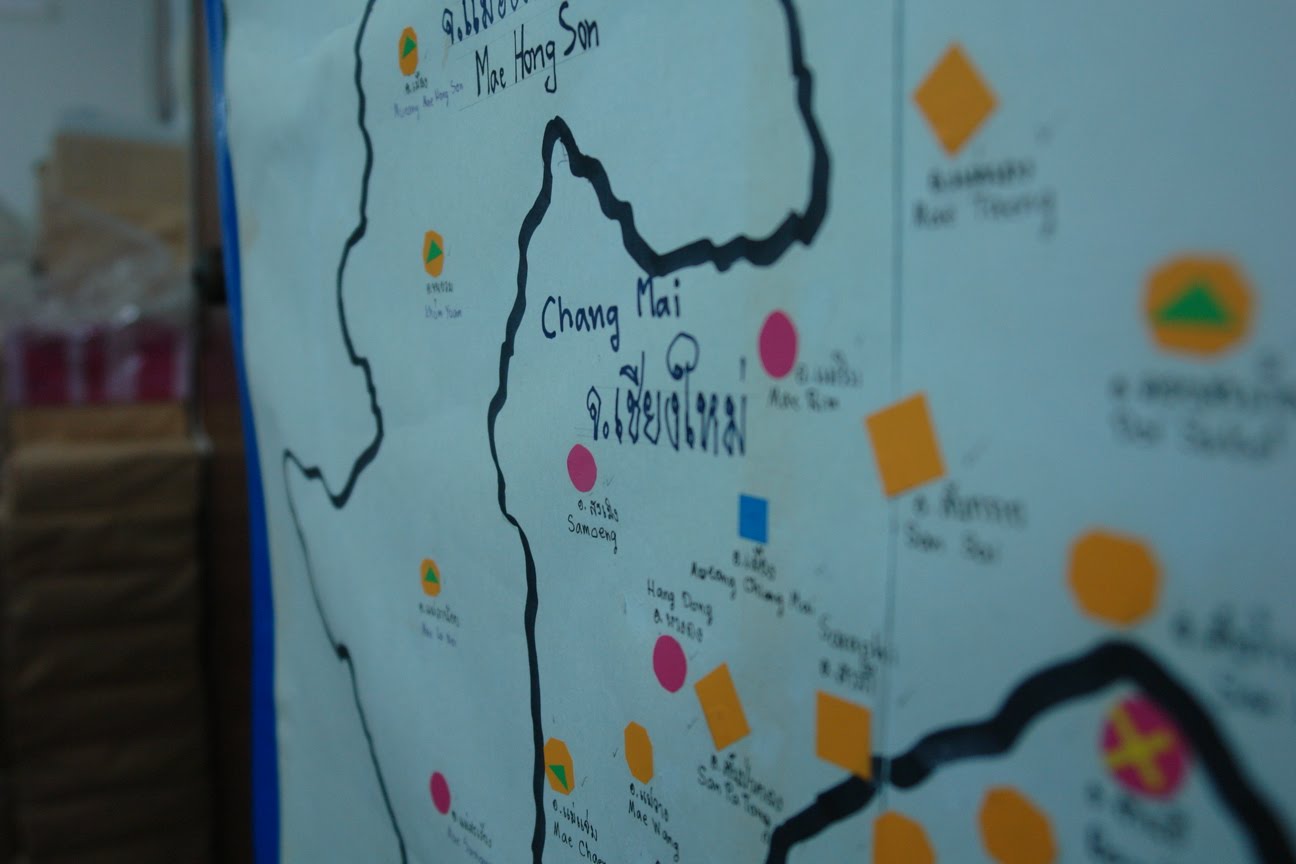
Map of HIV/AIDS groups in Northern Thailand

The objectives of this Foundation is to improve the quality of living of HIV victims, reduce the number of infected people, and help them integrate with society and return their lives to normalcy by removing the stigma that hovers over victims of HIV/AIDS through the Real Life Project. In addition, AIDSnet receives the support of local and international governments, Non Government Organizations (NGOs), people living with HIV/AIDS (PHA) and other community based organizations. The objectives of this Foundation is to improve the quality of living of HIV victims, reduce the number of infected people, and help them integrate with society and return their lives to normalcy by removing the stigma that hovers over victims of HIV/AIDS through the Real Life Project.

In the presentation by Ms. Mahawan we were told that their priority is the promotion of an improved health system. This is done through the organization’s close cooperation with the Health Department, providing blood tests and creating awareness among the people by educating them about contraceptives and how to live with HIV. The prevention campaigns are aimed particularly at groups considered as belonging to the high risk category- ethnic minority groups, youth, prisoners, the gays, lesbian, bisexual and transsexual community (GLBT) and men having sex with men (MSM). In order to help with their AIDS awareness campaign, AIDSNet also finds it is beneficial to them to co-operate with influential members of the community such as the monks, housewives and teachers, in order to reach a wider target audience.

Cyren conducting break-time refreshers

During the session we were also introduced to TNP+ as they work closely with AIDSNet to promote the assimilation of victims into the wider society. Mr. Kumona spoke extensively about the organization’s structure, activities and challenges that TNP+ faces. Through his speech, we discovered that the primary targets of their work- the ethnic minorities of Northern Thailand- reflected the recurrent interest of our trip in the marginalized groups within this region of Thailand.

Unlike other Thais, these ethnic minorities have limited access to health care and education, which is a major issue in controlling the spread of HIV. The seriousness of the HIV/AIDS situation in Thailand was highlighted when the speakers informed us of the reality of the situation where at least one member of each of their families is a victim of the disease. This reality is reflected in their endeavours which consist of organizing activities that involve the family of victims, who play a major role in providing support. Families, especially the children of victims, become involved in family camps where the organization will offer information, training and counselling. In fact, although the number of children that carry HIV virus is approximately 1,300, the number of children who are indirectly, but nevertheless, seriously affected is estimated to be 7,300. Similarly, the number of adults affected through proximity to direct victims is about 3,000 more than the number of victims themselves.

Mr. Kumona speaking, with Juta as translator

However all hope is not lost. With official statistics showing that reported AIDS cases have declined by approximately 90 percent between the periods of 2003 to 2006, it goes to show that organizations like AIDSNet and TNP+ have had a positive influence through the work that they do. Nevertheless, their work is far from complete. They hope to expand their work beyond HIV/AIDS aid and awareness programmes, branching out into other issues such as human rights, child rights and economic concerns.

By the conclusion of the session, we have discovered the relationship between the issues that are of our concern throughout our trip here in Chiang Mai. According to Ms. Mahawan, Northern Thailand is known to have a relatively higher rate of HIV infection cases compared to the rest of the country and this may be attributed to the fact that Northern Thais are primarily made up of minority groups who lack access to their rights and therefore, access to basic health care and education. During discussions, when questions were raised concerning sex workers, we were reminded of the fact that rather than dealing with sex workers directly, AIDSNet’s work is directed towards organizing networks and communities.

Presentation of gifts from Monash and ISOCM

We are looking forward to having our questions answered on Tuesday when we meet the group that advocates the rights of sex workers, Empower. The visit to AIDSNet has piqued our interest in the hope of learning more from the NGOs and groups that we plan on visiting tomorrow, true to the spirit of AIDSNet’s motto:
“No community or group can solve this alone; all must work together.”